ISO/IEC 27001 Compliance Explained: A Complete Guide for Businesses
ISO/IEC 27001 compliance provides organizations with a structured approach to protecting sensitive information and strengthening their overall security posture. This guide explains the core principles of the standard, outlines its key requirements, and walks through the implementation process from planning to certification. It also explores the business benefits of compliance, including improved risk management, regulatory alignment, and increased stakeholder confidence. Whether you’re new to information security or preparing for certification, this article offers practical insights to help your organization build and maintain an effective Information Security Management System (ISMS).
Understanding ISO/IEC 27001 Compliance: Importance and Business Value
ISO/IEC 27001 is an internationally recognized standard that helps organizations establish, implement, maintain, and continually improve an Information Security Management System (ISMS). It provides a risk-based framework for identifying security threats, protecting sensitive information, and ensuring that business-critical data remains confidential, accurate, and accessible.
Developed jointly by the International Organization for Standardization (ISO) and the International Electro technical Commission (IEC), the standard was originally introduced in 2005. It was revised in 2013 and most recently updated in 2022 to reflect evolving cybersecurity risks, emerging technologies, and modern information security practices.
Although ISO/IEC 27001 certification is voluntary, it has become a widely accepted benchmark for organizations that want to demonstrate a strong commitment to information security. Businesses across industries adopt the standard to strengthen their security controls, reduce cyber risks, meet customer and regulatory expectations, and build trust with clients and stakeholders.
Implementing ISO/IEC 27001 goes beyond achieving certification. It encourages organizations to create a culture of continuous risk assessment and improvement, helping them respond effectively to new threats while maintaining compliance with industry requirements. A well-managed ISMS can also improve operational resilience, minimize the impact of security incidents, and support long-term business growth.
In the following sections, we’ll examine the primary objectives of ISO/IEC 27001, its essential requirements, and the practical steps organizations can take to achieve and maintain compliance.
Key Objectives of ISO/IEC 27001 Compliance
The primary purpose of ISO/IEC 27001 compliance is to help organizations build a reliable and effective information security management framework. It focuses on protecting valuable information assets while reducing security risks and supporting long-term business continuity. By following the standard, organizations can create consistent security practices that safeguard data against evolving cyber threats.
The main objectives of ISO/IEC 27001 include:
- Ensure that sensitive business and customer information is accessible only to authorized individuals.
- Prevent unauthorized changes, corruption, or loss of information so that data remains accurate and trustworthy.
- Keep critical systems, applications, and data accessible to authorized users whenever they are needed.
- Identify, evaluate, and address information security risks through a structured risk management process.
- Establish technical, physical, and administrative safeguards that reduce vulnerabilities and strengthen overall security.
- Help organizations meet legal, regulatory, and industry-specific information security requirements.
- Regularly review and enhance security policies, processes, and controls to adapt to new threats and business changes.
- Demonstrate a commitment to protecting sensitive information, increasing confidence among customers, partners, and stakeholders.
With these objectives in place, organizations can build a resilient Information Security Management System (ISMS) that supports both operational efficiency and long-term business success.
Next, let’s explore the essential components that form the foundation of ISO/IEC 27001 compliance.
Core Elements of ISO/IEC 27001 Compliance
Achieving ISO/IEC 27001 compliance requires organizations to build a structured framework that protects sensitive information from security threats. Instead of relying on a single security measure, the standard combines policies, processes, technology, and employee awareness to create a strong information security environment. The following are the essential elements of an effective ISO/IEC 27001 compliance strategy.
Information Security Management Framework
An Information Security Management System (ISMS) serves as the foundation of ISO/IEC 27001. It provides a systematic approach to managing confidential information through clearly defined policies, responsibilities, and security procedures. A well-designed ISMS helps organizations protect business data, maintain operational continuity, and comply with legal and regulatory requirements.
Risk Identification and Risk Management
ISO/IEC 27001 follows a risk-based methodology, which means organizations must first identify information security risks before implementing security measures. This process includes evaluating potential threats, analyzing their impact on business operations, and determining the likelihood of occurrence. Once risks are assessed, appropriate actions can be taken to minimize or eliminate them.
Security Measures and Operational Controls
Organizations are required to implement security controls based on their specific business risks. These controls may include access management, data encryption, network protection, incident response procedures, physical security, supplier management, and employee security practices. Selecting the right controls ensures that critical information remains protected against both internal and external threats.
Ongoing Performance Evaluation
Information security is not a one-time project. ISO/IEC 27001 encourages organizations to regularly evaluate the effectiveness of their security management system through audits, performance reviews, and compliance monitoring. Continuous evaluation helps identify weaknesses and ensures that security practices remain effective as technology and cyber threats evolve.
Continuous Improvement Process
One of the key principles of ISO/IEC 27001 is continual improvement. Organizations should regularly update security policies, improve risk management practices, and strengthen existing controls based on audit findings, security incidents, and changes in business requirements. This proactive approach helps maintain a resilient and adaptable security management system.
ISO/IEC 27001 Implementation Process
Implementing ISO/IEC 27001 involves creating, operating, maintaining, and continuously improving an Information Security Management System. A structured implementation process enables organizations to reduce security risks while protecting valuable business information. Below are the major stages involved in ISO/IEC 27001 implementation.
Define the Scope of the ISMS
The first step is to determine the boundaries of the Information Security Management System. Organizations should identify the departments, business processes, locations, technologies, and information assets that will be covered under the ISMS. Clearly defining the scope ensures that security efforts focus on the most critical areas of the business.
Conduct a Comprehensive Risk Assessment
A detailed risk assessment helps organizations understand the vulnerabilities affecting their information assets. This process involves identifying threats, evaluating their business impact, and prioritizing risks based on their severity. A thorough assessment forms the basis for selecting suitable security controls.
Develop a Risk Treatment Strategy
After evaluating risks, organizations create a risk treatment plan that outlines how identified risks will be managed. The plan may involve reducing risks through security controls, transferring risks to third parties, accepting low-level risks, or avoiding high-risk activities altogether. Every decision should align with the organization’s security objectives and business goals.
Implement Security Controls
Once the treatment plan is finalized, appropriate administrative, technical, and physical controls are deployed. Common examples include implementing multi-factor authentication, encrypting sensitive information, restricting user access, establishing backup procedures, securing physical facilities, and developing incident response plans.
Build Employee Awareness
Employees play a critical role in information security. Organizations should conduct regular awareness programs and security training to educate staff about cyber threats, password management, phishing attacks, data protection practices, and company security policies. A security-aware workforce significantly reduces human-related risks.
Monitor, Audit, and Review the ISMS
Regular monitoring ensures that security controls continue to perform as expected. Internal audits, management reviews, vulnerability assessments, and incident analysis help organizations identify gaps and improve the effectiveness of their Information Security Management System. Continuous monitoring also supports ongoing compliance with ISO/IEC 27001 requirements.
Achieve ISO/IEC 27001 Certification
Although certification is not mandatory, many organizations choose to become ISO/IEC 27001 certified to demonstrate their commitment to information security. Certification is granted after an accredited certification body verifies that the organization’s Information Security Management System meets the requirements of the ISO/IEC 27001 standard. Achieving certification enhances customer trust, strengthens business credibility, and provides a competitive advantage in the marketplace.
Steps to Achieve ISO/IEC 27001 Certification
ISO/IEC 27001 certification demonstrates that an organization has implemented a robust Information Security Management System (ISMS) to protect sensitive information. The certification process involves careful planning, risk management, implementation of security controls, and independent verification by a certification body. Below are the essential steps to achieve ISO/IEC 27001 certification.
Understand the Standard and Plan Your Approach
The first step is to gain a clear understanding of the ISO/IEC 27001 framework and its requirements. Organizations should familiarize themselves with the standard, identify its benefits, and secure management support before beginning implementation. Establishing a well-defined roadmap with objectives, timelines, and responsibilities helps ensure a smooth certification process.
Evaluate Your Current Information Security Practices
Before implementing new controls, assess your existing information security processes. A gap analysis helps identify areas where your current ISMS does not meet ISO/IEC 27001 requirements. This evaluation enables organizations to prioritize improvements and allocate resources effectively.
Perform Risk Assessment and Build the ISMS
Risk management is a fundamental requirement of ISO/IEC 27001. Organizations should identify valuable information assets, evaluate potential threats and vulnerabilities, and determine the level of risk associated with each one. Based on the findings, develop an Information Security Management System that includes documented policies, procedures, security objectives, and appropriate controls.
Implement Security Measures
After designing the ISMS, organizations must put the selected security controls into operation. These controls may include access management, encryption, network protection, data backup, incident response procedures, and employee awareness programs. Proper implementation ensures that identified risks are effectively managed.
Conduct Internal Reviews
Regular internal audits help verify whether the ISMS is operating as intended and complies with ISO/IEC 27001 requirements. These assessments identify weaknesses, process gaps, and opportunities for improvement before the external certification audit. Corrective actions should be completed to strengthen the system.
Complete the Certification Audit
The certification audit is performed by an accredited certification body and is generally divided into two stages:
- Stage 1 Audit: Auditors examine the organization’s ISMS documentation to confirm that it meets the requirements of ISO/IEC 27001 and is ready for formal assessment.
- Stage 2 Audit: Auditors evaluate the practical implementation of the ISMS by reviewing security controls, operational processes, employee awareness, and overall compliance with the standard.
If the organization successfully satisfies the audit requirements, ISO/IEC 27001 certification is awarded.
Resolve Audit Findings
If any nonconformities are identified during the certification audit, the organization must address them through corrective actions. Once the issues have been resolved and verified by the certification body, the certification process can be completed successfully.
Maintain Ongoing Compliance
Achieving certification is only the beginning. Organizations should continuously monitor and improve their Information Security Management System to adapt to evolving security risks. Annual surveillance audits are typically conducted to verify continued compliance, while recertification audits are generally required every three years to maintain certification.
Improving Information Security Through Secure Data Erasure
An effective information security strategy includes securely disposing of sensitive data that is no longer required. Professional data wiping solutions can support this objective by permanently removing confidential information from storage devices, reducing the risk of unauthorized access and data leakage.
Advanced CubexSoft Data Wipe Software uses recognized overwrite methods to replace existing information with new data patterns, making the original content extremely difficult to recover through conventional recovery techniques. This process is especially useful when retiring, reusing, or disposing of computers, hard drives, SSDs, and other storage media.


Incorporating secure data erasure into an organization’s Information Security Management System helps strengthen data lifecycle management, supports regulatory compliance, and minimizes the risk of data breaches. While data wiping tools can enhance an organization’s overall security posture, they should be implemented as part of a comprehensive ISO/IEC 27001 compliance program that includes risk management, security controls, employee awareness, and continuous improvement.
Conclusion
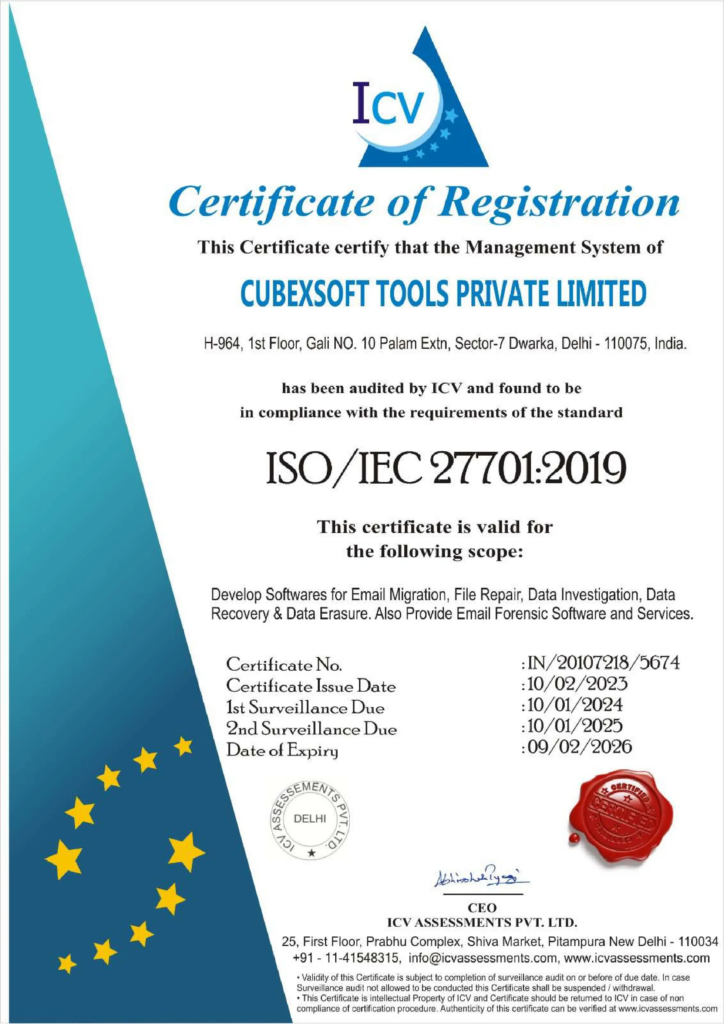
ISO/IEC 27001 provides organizations with a globally recognized framework for establishing, managing, and continually improving an Information Security Management System (ISMS). By implementing its requirements, businesses can protect sensitive information, reduce cybersecurity risks, strengthen regulatory compliance, and build greater trust with customers and stakeholders. Beyond improving data security, ISO/IEC 27001 certification also enhances an organization’s reputation and demonstrates its commitment to maintaining high information security standards.
Since information security is an ongoing process, organizations should regularly review their security controls, assess emerging risks, and update their ISMS to address evolving threats. Additionally, incorporating secure data erasure solutions into your information security strategy helps ensure that confidential data is permanently removed from retired or reused storage devices, reducing the risk of unauthorized access and data breaches. Combined with a well-managed ISMS, secure data wiping supports stronger data protection and contributes to long-term ISO/IEC 27001 compliance.
